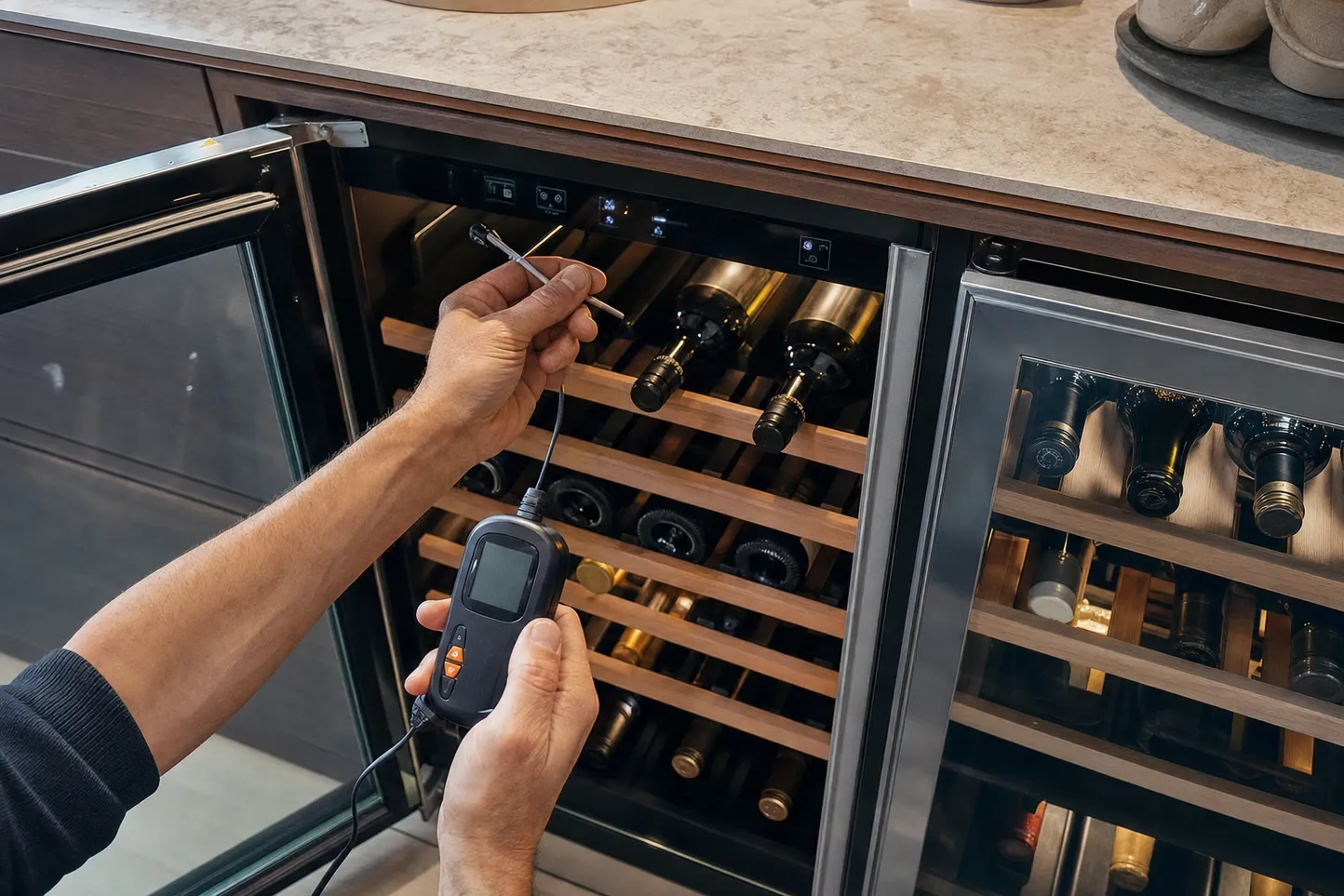
The repair against the replacement
| What it takes | Range |
|---|---|
| Compressor or sealed-system repair | $1,510–$3,440 |
| Buying another one instead | $12,710–$21,440 |
That last row buys a like-for-like built-in on its own, with nothing allowed for fitting it or for the joinery around it. Every figure above it is being weighed against that, which is why a structurally sound cabinet is usually worth putting right even when the quote makes you wince.
Age is the first thing blamed and the last thing measured. A built-in from the early nineties that will not hold temperature is usually suffering from what a new one would — a condenser nobody has cleaned in a decade, a seized fan, a defrost circuit that quietly stopped — and the refrigerant on its plate plays no part in any of it.
What the plate is telling you
The rating plate carries the model number, the serial number, the month and year of manufacture, the charge for each compartment, the total amps, and the refrigerant type as a field of its own. On the older built-ins that line reads R-12. It is a specification like the amperage beside it: a record of how the machine was built, not of how it is running this week.
Under the American ozone rules the CFCs are class I substances that have been phased out, so with narrow exceptions they are no longer produced or imported here. That matters to whoever opens the circuit. While it is intact, nothing in your kitchen changes.
Why the circuit is the last place anyone looks
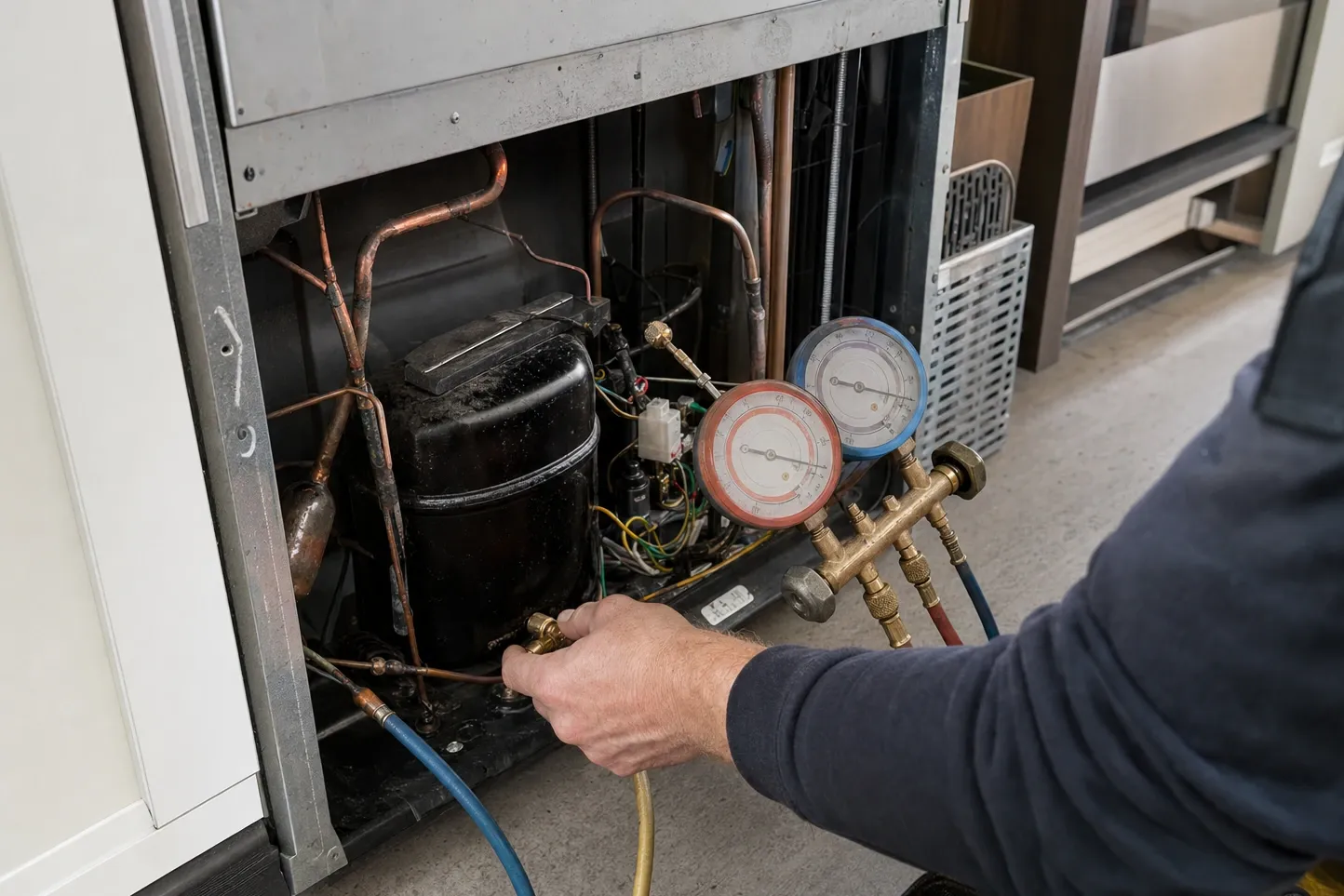
Sub-Zero’s own instruction is to reach the sealed system only after the code table and the general checks fail to account for the temperature. When it is reached, solder-on process valves go in rather than the bolt-on kind, and the high-side filter-drier is replaced as part of the work. That order exists because most warm cabinets are not sealed-system faults, and because opening a circuit that did not need opening is the one mistake on an old machine nobody can take back.
Nothing here is an owner task either: gauges, recovery and the pipework behind the grille need the kit that goes with them.
The condition that decides it
Not the refrigerant — the integrity of the circuit holding it. A cabinet never opened, still sealing at the doors, with a plate you can read, is worth measuring and worth keeping. One that has lost its charge twice with the leak never pinned down is paying for one repair on repeat, and that is where the last row starts to make sense.
What we usually find
-
A cabinet from the early nineties cooling poorly, with its age offered as the explanation
Heat rejection, in most of these. A condenser packed solid and a fan that has stopped turning produce the same complaint, and neither has anything to do with what is inside the tubing.
Evaporator or condenser fan motor $330–$750
-
A machine that was charged once already and is drifting warm again within the same year
A leak nobody located. Refrigerant is not consumed by running; if a charge has gone twice, the second visit is about finding where it went rather than replacing it again.
Compressor or sealed-system repair $1,510–$3,440
-
An old plate reading R-12 on a cabinet that is still holding its temperature
No fault at all. What that line records is when the machine was built, and a sound circuit from that era is measured, left alone and used.
Quoted after the diagnosis
Which of these it is gets settled at the visit, before a part is ordered — Sub-Zero Repair Pro Los Angeles, (310) 844-1973.
Which way it points
Repair it if
- The plate is intact and nobody has ever opened the sealed circuit on this machine
- The complaint has not yet been traced past the condenser, the fans and the defrost
- The doors seal, the liner is dry and the kitchen around the opening is staying as it is
Replace it if
- This is a second loss of charge on the same circuit and the first leak was never named
- The leaking section is the coil inside the foamed wall rather than reachable pipework
- The plate has gone, the model cannot be established and no parts search can begin
If your machine sits between the two columns, that is what the diagnosis is for: Sub-Zero Repair Pro Los Angeles measures it first and gives you the figure before any of it is committed to — (310) 844-1973.
Follow-ups
- Where do I find out which refrigerant my Sub-Zero uses?
- The rating plate prints it as its own field, next to the charge weights and the total amps, and on the older built-ins that plate sits by the top door hinge. Photograph the whole plate rather than one line of it and Sub-Zero Repair Pro Los Angeles can work from that before anybody visits.
- Can an older cabinet simply be topped up each year?
- It should not have to be. A circuit that holds its charge keeps it for the life of the machine, so a yearly top-up is a leak being paid for on instalments rather than repaired. The useful visit is the one that measures the pressures and finds the loss. Call (310) 844-1973.
- Written by
- Yuki Tanabe
- Role
- Refrigeration technician — controls and sensors
- In the trade
- 18 years in the trade