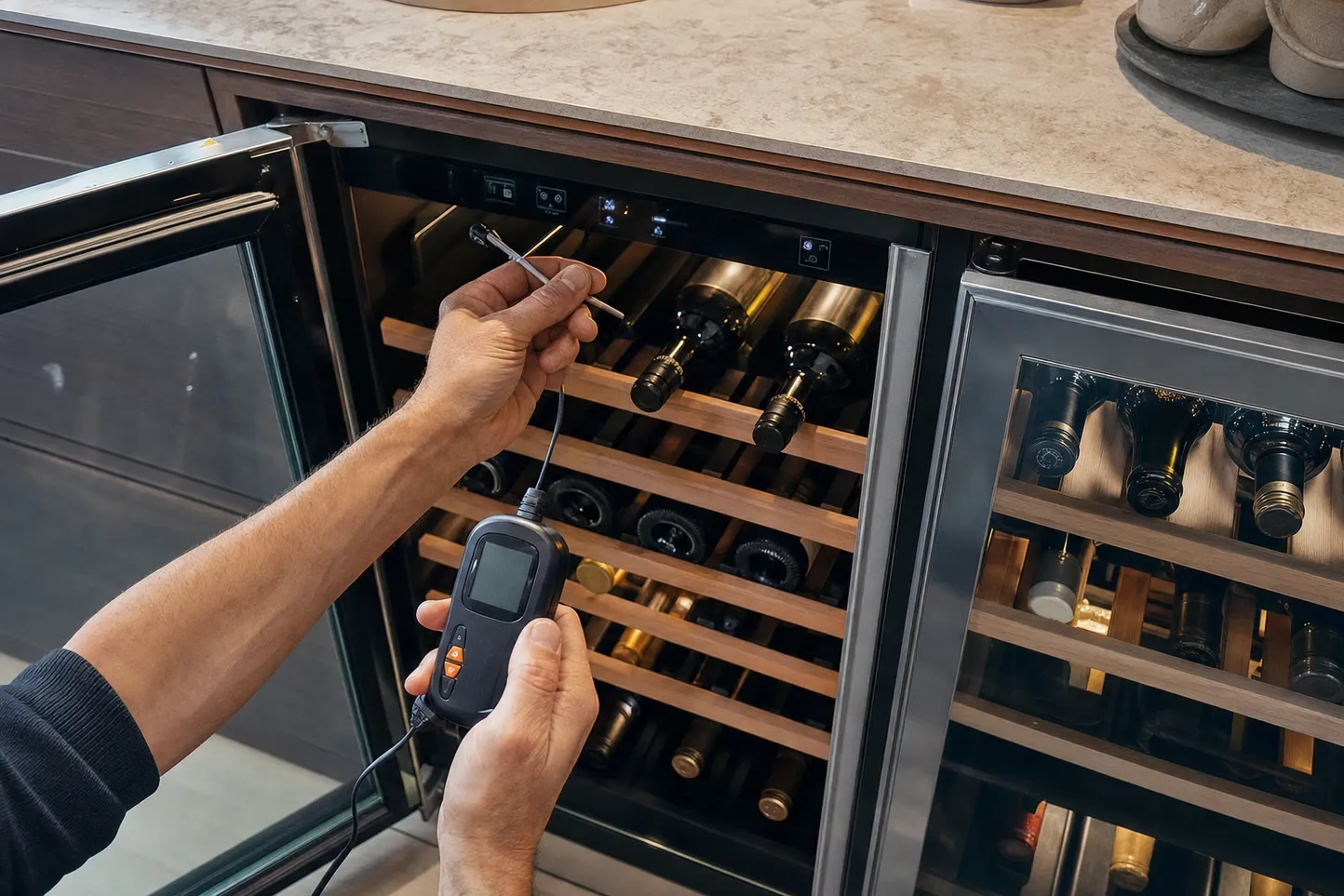
Refrigerator Repair
What thirty Valley summers do to a built-in refrigerator
Written byYuki TanabeRefrigeration technician — controls and sensors · 18 years in the trade
Heat does not break a built-in; it decides the order in which things give out. What accumulates over thirty summers on the Encino side of the hill, and in what sequence.
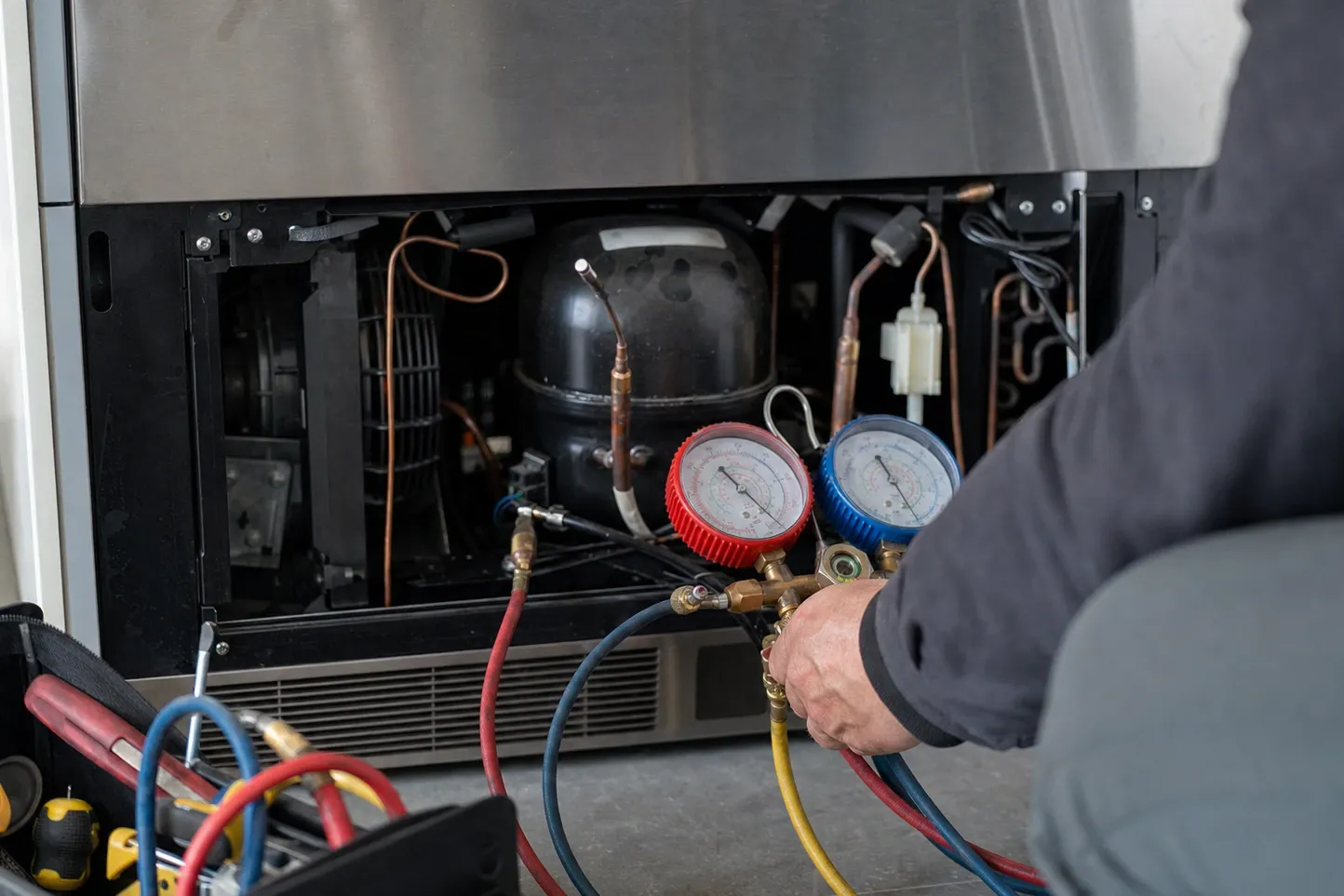
Nothing dramatic happens to a built-in in a hot kitchen. What we usually find on a cabinet that has worked thirty summers on the Valley floor is not one failure but a sequence — the same components giving out in roughly the same order, each one a little earlier than it would have somewhere cooler. Heat does not break these machines. It sets the running order.
What the manufacturer asks of the room
There is a figure behind all of this, and it comes from Sub-Zero’s own troubleshooting guide rather than from anyone’s opinion about the weather. Under the heading for a high room ambient, the remedy printed beside it is to instruct the customer that the unit performs best between 60°F (16°C) and 90°F (32°C).
Read that as a duty cycle rather than a limit. A kitchen in Encino or Northridge that sits near the top of the window through a long afternoon is asking the condenser to shed heat into air that is already warm. The compressor runs longer to reach the same setpoint, the off cycle shortens, and a machine designed to rest for part of every hour stops resting. Nothing has failed. Everything is simply working closer to its ceiling, for more hours of the year, for thirty years.
The order things give out
First the condenser loads up. Dust and lint pack into the fin pack behind the grille, and the surface that is supposed to be throwing heat away stops being able to. The manufacturer treats this as an owner’s job and is specific about it: clean the condenser every six to twelve months, reach it by pulling out the bottom edge of the flip-up grille and rotating it up, use a soft bristle brush and a vacuum, work in the direction of the fins, switch the power off at the control panel beforehand and wear gloves, because the fins cut. The warning attached to that instruction is blunt — failing to clean it can cost temperature, and can cost the machine.
Next the condenser fan. It is the part that has been asked to do the most extra work, and the documented failures around it are a short list: a blade obstructed or gone loose on the shaft, a motor disconnected, a motor that has simply given up, or no power reaching it from the control board. A cabinet with a loaded fin pack and a fan that no longer turns has lost both halves of its heat rejection at once.
Then the door. Every hot hour the seal is imperfect is a heat load the machine has to take back out again, and the manufacturer’s cause list for a warm compartment pairs a door left ajar with a hinge that has stopped pulling the door home. On an old cabinet these two are hard to tell apart from the outside, which is why they get checked with a strip of paper rather than by eye.
Only then does the control start complaining. The codes that count run time — the excessive-run entries for each compartment — are what a long summer eventually produces, and they name the compressor while pointing at everything in front of it. The error code and indicator reference sets out what each reading is actually watching.
What the display will tell you, and what it will not
It depends entirely on how old the machine is. On the current Classic generation one indicator covers three quite different situations: it lights or flashes when the control detects a temperature problem, when the ice maker has a problem, or when the condenser needs cleaning. That last case is the one worth knowing about, because it is the cheapest thing a warning light has ever meant.
The earlier 600 Series stores no numbered codes, and its condenser warning is a separate one: the words VACUUM CONDENSER flashing on the display. That is the same message in older vocabulary — the condenser is the first place to look. This generation lights SERVICE as well, but for a thermistor fault rather than for airflow, so the two words are not interchangeable. A 500 Series has no display at all, and tells you the same story through run time, frost and which compartment loses ground first.
Where the sealed system finally comes into it
It comes in last, and it should. The manufacturer’s own list of causes for warm compartments puts room ambient and condenser airflow at the top and the sealed system at the bottom, in that order, and there is a quiet detail in the pressure tables that explains why a hot kitchen complicates even the measuring: the reference pressures are based on a 70°F ambient, and the manual lists ambient temperature among the reasons a real reading will differ from the book.
None of which means a thirty-year-old machine is beyond help. It means the expensive answer has to be the last one eliminated rather than the first one reached for, and that when it genuinely is the sealed system, the decision deserves the full comparison in a compressor quote against the price of a new built-in.
What this changes about living with one
Not much, and that is the useful part. Keep the fin pack clean at the shorter interval, keep the grille clear of anything stacked against it, and treat a summer of constant running as information rather than as bad luck. Most of the sequence above is cheap while it is still early in the order, and expensive once it has been left long enough to reach the end of it. The Encino service page covers what that looks like on the Valley side of the sector specifically.
A diagnosis is $89 and it produces numbers — ambient, compartment temperatures against setpoint, condenser condition, fan rotation, the run pattern across a full cycle. Sub-Zero Repair Pro Los Angeles takes bookings on (310) 844-1973.
Follow-ups
- Is Valley heat genuinely bad for a built-in refrigerator?
- It is a workload rather than damage. Sub-Zero instructs its technicians to tell owners the unit performs best between 60°F (16°C) and 90°F (32°C) of room ambient, and a kitchen sitting at the top of that window leaves the condenser no headroom. The cabinet still cools. It simply rests less, and everything downstream ages to that rhythm.
- How often should the condenser be cleaned on a machine that works this hard?
- The current use and care guide asks for every six to twelve months, behind the flip-up grille, with a soft bristle brush and a vacuum worked along the direction of the fins and the power switched off at the control panel first. Where afternoons run hot, the shorter end of that interval is the sensible one to keep to.
- It runs without stopping on hot afternoons. Does that mean the compressor is going?
- Usually not, and the order of the checks is the whole point. Room ambient and condenser airflow head the manufacturer's own cause list for warm compartments; the sealed system sits at the bottom of it. Sub-Zero Repair Pro Los Angeles rules the cheap causes out first, on (310) 844-1973, for an $89 diagnosis.